
Ingroup preferences, segregation, and intergroup contact in neighborhoods and civic organizations
Published in PNAS Nexus, 2025
To what extent do individuals prefer social settings whether others have similar sociodemographic characteristics as themselves?
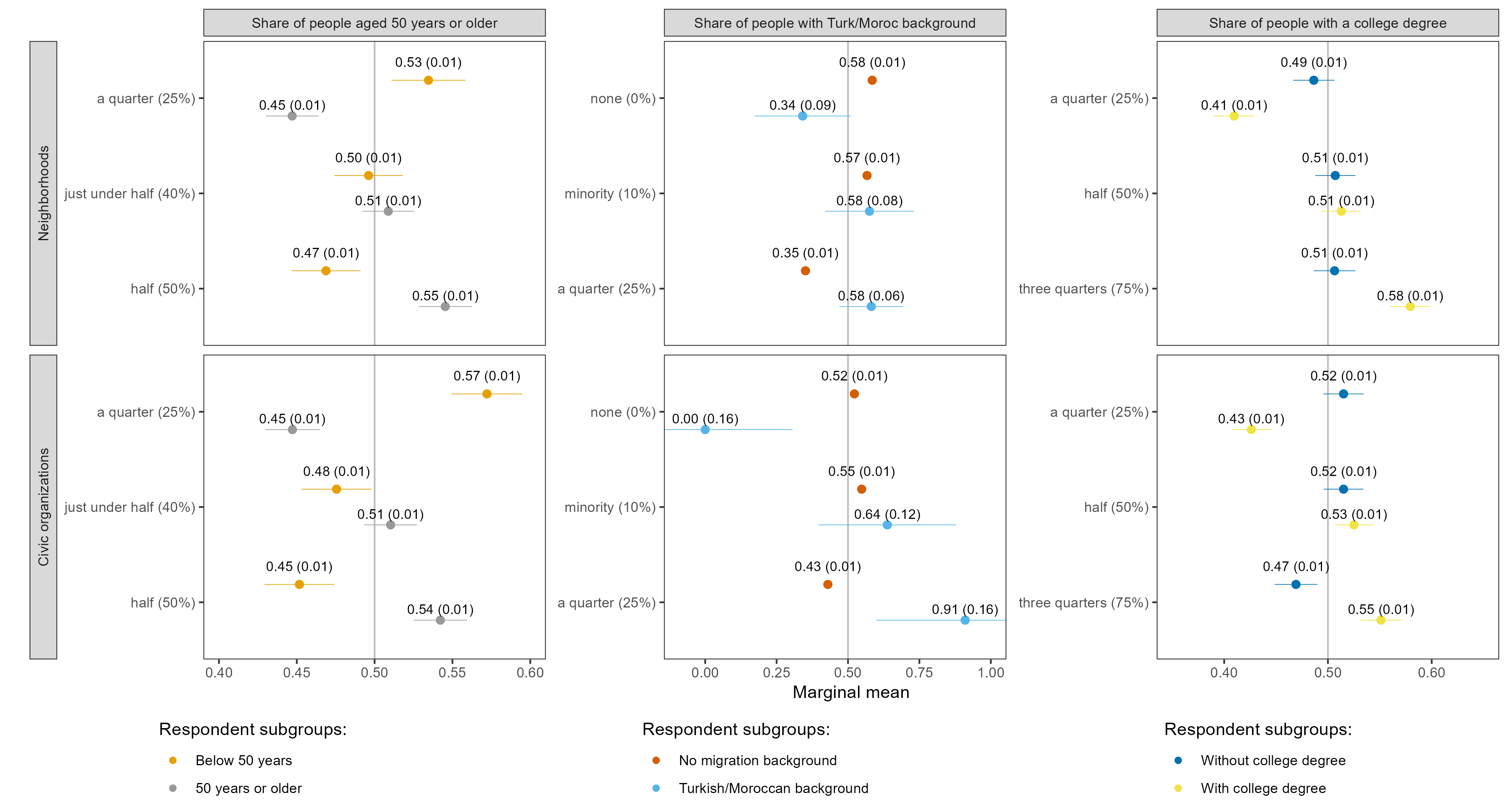
We compare such ingroup preferences regarding the composition of neighborhoods and civic organizations with respect to age, education, and ethnicity. Three survey experiments show that ingroup preferences (i) are commonplace along all three dimensions and in both settings; (ii) are stronger among individuals who have little exposure to outgroups; (iii) but do not depend on the expected intensity of contact. Lower-educated individuals are the only exception to this pattern, as they do not display any ingroup preferences along educational lines. Overall, these findings underscore the pervasiveness of ingroup preferences and their relevance for any efforts to reduce segregation.
Recommended citation: Dederichs, K., Franken, R., Wiertz, D., and Tolsma, J. (2025). "Ingroup preferences, segregation, and intergroup contact in neighborhoods and civic organizations" PNAS Nexus. 4(9), pgaf256.
Download Paper | Download Bibtex